
Om arrangementet
An evening for those who love Schubert. And for those who believe classical song is not for them. A concert for anyone who wants to feel why this music, nearly 200 years after its creation, remains so radically relevant today.
Not a museum piece. A Winterreise for our time.
Schubert’s Winterreise is considered one of the most significant song cycles of the Romantic era—a work exploring solitude, alienation, loss, longing, and the quiet possibility of hope. And yet, to this day, it is often treated like a museum masterpiece:
The singer stands rigidly beside the grand piano.
The pianist accompanies.
The audience listens reverently from a safe distance.
But how can that be—given the energy, urgency, and inner radicalism of this music?
Winterreise is not merely a beautiful art-song recital.
It is a journey to the outer limits of human experience.
Julia Aldinger and Stefan Bien liberate Winterreise from the purely traditional concert format. Voice, piano, body, space, and silence enter into dynamic relationship with one another.
The singer does not simply remain standing next to the piano.
The space itself becomes part of the narrative.
The audience transitions from mere listeners to active counterparts.
Proximity, distance, movement, gaze, breath, and silence become musical elements. The result is not a historical museum exhibit, but an immersive space of experience: immediate, vulnerable, and intense.
Staged by award-winning young director Lea Willeke (Berlin).
Audience Reactions to Our Interpretation
“You could have heard a pin drop.”
“I am completely exhausted, but happy.”
"I have heard Winterreise many times, but this was unique."
“You must have experienced a great deal to be able to sing like that.”
“Ms. Aldinger plays Schubert with such lightness—unmatched.”
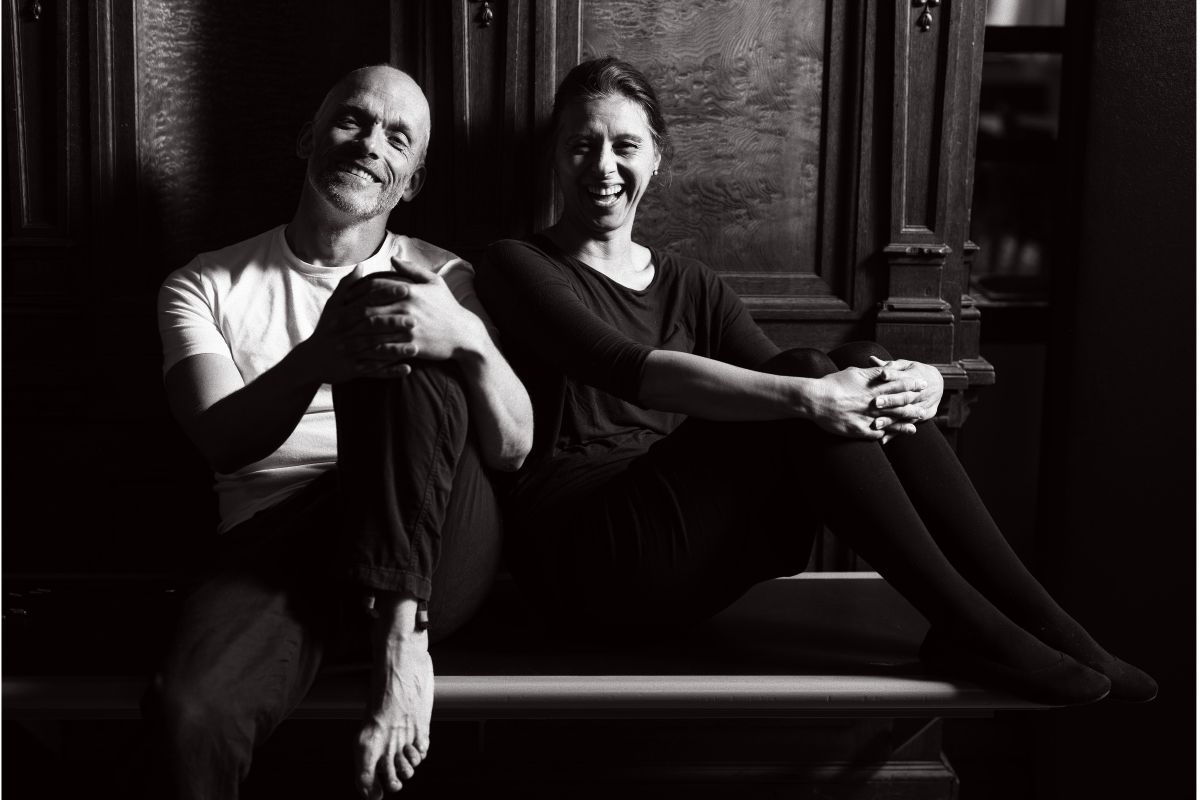
Duo ju:st Lied: Stefan Bien (baritone) & Julia Aldinger (piano)
Stefan Bien was a top executive and CEO of an international online marketing company, navigating a world of start-up growth, corporate logic, target metrics, and constant self-optimization. Following a burnout, an inner collapse, and a period in which even the question of continuing to live was no longer abstract, he walked the Camino de Santiago. It was there that something began that had less to do with career planning than with survival: he followed a calling that had accompanied him since childhood.
At the age of twelve, he heard Schubert’s Winterreise for the first time. The work never let him go.
Today, he sings this cycle as a baritone—not from a safe distance, not as an academic interpretation, but from deep biographical proximity. For him, the wanderer’s inner abysses are not historical motifs. They are lived experiences. Thus, Winterreise is not merely portrayed, but truly lived through.
Julia Aldinger comes from a German-Russian family of pianists. Her father, himself a concert pianist, shaped her musical language at an early age. She studied in Dresden, Weimar, and St. Petersburg, receiving artistic inspiration through masterclasses with Peter Schreier, András Schiff, Gerold Huber, and Olaf Bär.
Following an intensive period of concert performance, she chose to focus on family and science, working for several years in cancer research at the Helmholtz Centre. In 2024, she returned to her roots as an art-song pianist.
Together, Aldinger and Bien share a mission: to liberate the art song from its niche and bring it dynamically into the present.
Foto: Kai Rimpel
Arrangør: ju:st Lied